Peptide Storage Guide Temperature, Light, and Stability for Research Compounds
· 7 min read ·
Written by Clark Jones
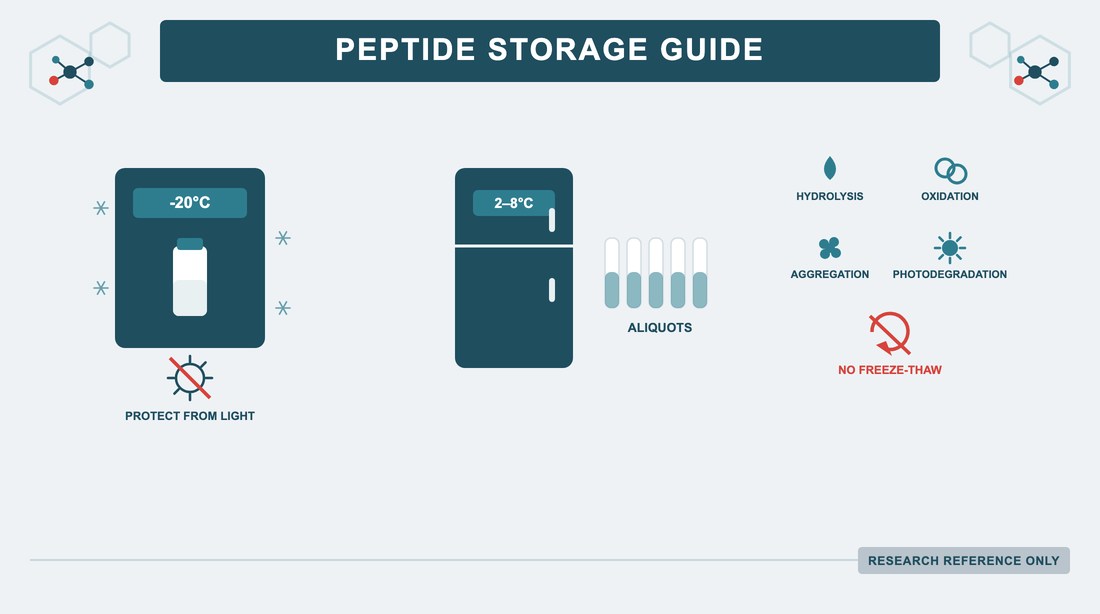
Quick answer: Store lyophilized peptides sealed at -20°C, protected from light. Once reconstituted, keep the working stock at 2 to 8°C, still protected from light, and avoid repeated freeze-thaw cycles by working in single-use aliquots. Some peptide classes have extra sensitivities worth knowing: copper complexes like GHK-Cu are photochemically active, and any peptide’s specific usable window should come from its batch Certificate of Analysis rather than a generic number.
Research use only: what this article is, and what it isn’t
This is a laboratory handling guide for storing research-grade peptides used in in vitro, ex vivo, and in silico work. It is not medical advice and not a guide to any human use.
Research peptides are supplied for laboratory research only, not for human consumption, veterinary use, or in vivo use in any species. Good storage is part of good research practice: it is how you keep a compound intact between the day it arrives and the day it goes into an assay. Researchers are responsible for compliance with applicable law, including the Federal Food, Drug, and Cosmetic Act (21 U.S.C. § 331, § 355, § 360bbb-3), and institutional review requirements.
The two states, two rules
Peptides exist in two states in your lab, and each has its own storage logic.
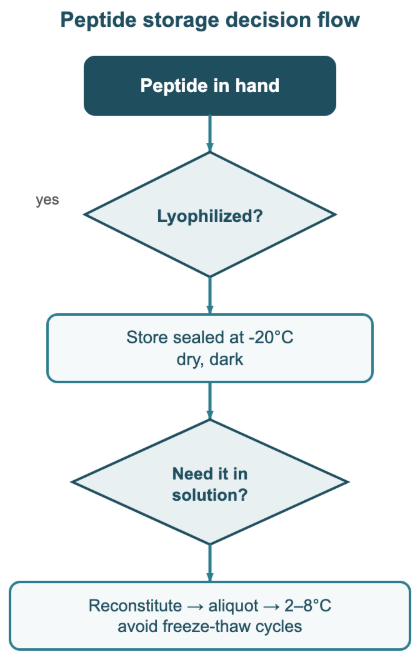
Lyophilized (dry) powder is the stable state. Freeze-drying removes the water that drives most degradation reactions, which is why peptides ship this way. Kept sealed at -20°C in a dry, dark environment, lyophilized peptide is at its most durable. The enemy here is moisture: a vial left open to humid air, or one cycled in and out of a cold freezer so that condensation forms inside, picks up water that starts the degradation clock.
Reconstituted (in solution) is the vulnerable state. Once the peptide is back in water, several degradation routes open up at once. The major ones for peptides and proteins are hydrolysis of the peptide backbone, oxidation of susceptible residues, and physical aggregation, all of which are catalogued in the peptide-stability literature (Manning et al., *Pharmaceutical Research*, 2010). Refrigerate the working stock at 2 to 8°C, protect it from light, and minimize how long it spends at room temperature. This is why single-use aliquots are worth the extra pipetting: each freeze-thaw cycle stresses the peptide, and aliquoting means you thaw only what you need.

Storage at a glance
| State | Temperature | Light | Key risk to manage |
|---|---|---|---|
| Lyophilized, sealed | -20°C | Protect from light | Moisture ingress, condensation from freezer cycling |
| Reconstituted stock | 2 to 8°C | Protect from light | Hydrolysis, oxidation, repeated freeze-thaw |
| Reconstituted, single-use aliquots | 2 to 8°C, or frozen per protocol | Protect from light | Freeze-thaw stress (avoid re-freezing thawed aliquots) |
These temperature ranges are established peptide-chemistry conventions. They are not a substitute for the specific stability information on a product’s Certificate of Analysis. The formal framework for how stability windows are actually established, through controlled testing at defined temperature and humidity conditions, is set out in the international harmonized stability guideline ICH Q1A(R2) (ICH Q1A(R2), Stability Testing of New Drug Substances and Products). When a study depends on a precise usable window, that window should come from the manufacturer’s validated stability data, the batch COA where applicable, or your own validated stability data, not a generic shelf-life figure.
Sensitivities that vary by peptide class
Not every peptide degrades the same way, and a few classes have specific vulnerabilities worth flagging.
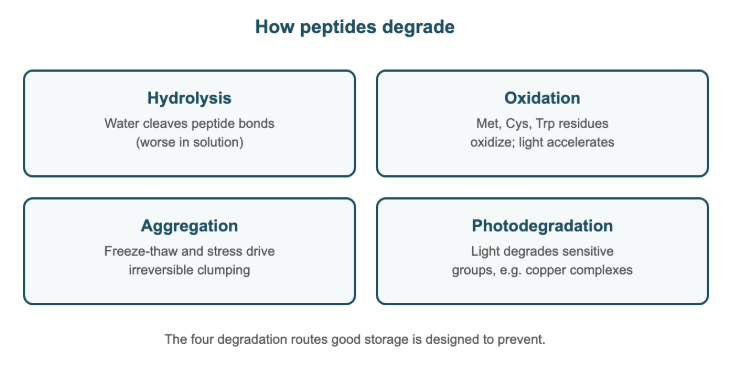
Copper complexes are light-sensitive. GHK-Cu carries a copper(II) ion whose photochemistry makes the complex susceptible to light-driven degradation. An amber vial or a foil wrap is a cheap, effective safeguard, and a visible color change in the reconstituted solution is an early warning that the complex may be dissociating.
Oxidation-prone residues. Peptides containing methionine, cysteine, or tryptophan are more susceptible to oxidation, particularly in solution and with light exposure. Minimizing air headspace and light exposure helps, which is another argument for small single-use aliquots.
Larger and modified peptides. More complex molecules, including stabilized analogs with engineered modifications, are worth handling conservatively because a subtle structural change can be harder to detect by eye. The COA is where you confirm the material started intact; careful storage is how you keep it that way.
The do and don’t list
- Do keep lyophilized vials sealed at -20°C in a dry, dark place.
- Do let a cold vial equilibrate to room temperature before opening, to avoid condensation inside.
- Do aliquot reconstituted stock into single-use portions.
- Do protect light-sensitive compounds like GHK-Cu with an amber vial or foil.
- Don’t subject reconstituted peptide to repeated freeze-thaw cycles.
- Don’t rely on a generic shelf-life number when your study needs a precise window; use the batch COA.
- Don’t use a solution that has gone cloudy, precipitated, or changed color.
Five storage mistakes that ruin peptides
Most degraded peptides trace back to a small set of avoidable handling errors. These are the ones I see most often.
- Opening a frozen vial immediately. Cold glass pulled straight from a -20°C freezer draws condensation from room air onto and into the vial. That moisture is exactly what the lyophilized state was protecting against. Let the vial equilibrate to room temperature, sealed, before you open it.
- Repeated freeze-thaw cycles. Each cycle drives aggregation and denaturation. Reconstitute into single-use aliquots so you never thaw the same tube twice.
- Storing in a frost-free (auto-defrost) freezer. Frost-free freezers work by cycling through brief warming periods to prevent ice buildup, which means the contents experience repeated small temperature swings. A manual-defrost freezer holds a steadier temperature and is the better choice for peptide storage.
- Leaving samples exposed to bench light. Ambient light accelerates oxidation and, for light-sensitive compounds like copper complexes, direct photodegradation. Keep vials dark, and use amber or foil-wrapped tubes for the sensitive ones.
- Leaving aliquots at room temperature. Extended time at room temperature generally accelerates degradation reactions compared with refrigerated storage.Thaw only what you need, keep it cold while you work, and return the rest to storage promptly.
What to check on the Certificate of Analysis
Storage guidance is only as good as the material you started with, and the Certificate of Analysis is where you confirm that starting point. Before relying on any storage window, check the COA for:
- Identity confirmation by mass spectrometry, so you know the vial contains the compound the label claims, including any modification.
- Purity by HPLC, typically specified at 99% or higher, ideally with a chromatogram rather than a bare percentage.
- Analytical methods used, so you can see how identity and purity were actually determined.
- A retest or expiration date, where provided, which tells you the manufacturer’s assessment of how long the material holds.
- Storage recommendations specific to that product and batch.
For a full walkthrough of every COA section and how to read it, see our guide to reading a peptide Certificate of Analysis.
“Improper storage is where good material quietly goes bad, and the failure is usually invisible until the assay does not reproduce. The two habits that prevent almost all of it are simple: keep the dry powder cold and dry, and aliquot the solution so you never freeze-thaw the same tube twice. Everything else is refinement on top of those two.”
Clark Jones, PhD, Velora Research
Working with verified material
Velora Research ships research peptides as lyophilized powder with -20°C storage guidance and a batch-specific third-party Certificate of Analysis confirming identity and purity. The full research peptide catalog follows the same release protocol, and the quality and testing process is documented end to end. Starting with verified, intact material and storing it correctly is what keeps a compound reliable from the day it arrives to the day it goes into a study.
Frequently asked questions
What temperature should peptides be stored at?
Lyophilized peptides: sealed at -20°C, protected from light. Reconstituted peptides: refrigerated at 2 to 8°C, protected from light. -80°C storage may be appropriate for certain long-term research collections. These are established peptide-chemistry conventions.
How long does a reconstituted peptide last?
That depends on the specific compound, and the reliable answer comes from the batch Certificate of Analysis or your own validated stability testing rather than a generic figure. Working in single-use aliquots and avoiding freeze-thaw cycles preserves the material for longer.
Why should I avoid freeze-thaw cycles?
Each freeze-thaw cycle stresses the peptide and can drive aggregation and denaturation. Aliquoting the reconstituted stock into single-use portions means you only thaw what you need.
Which peptides are light-sensitive?
Copper complexes such as GHK-Cu are photochemically active and should be protected with an amber vial or foil. Peptides with oxidation-prone residues (methionine, cysteine, tryptophan) also benefit from reduced light and air exposure.
Can I refreeze a thawed peptide aliquot?
It is best avoided. Re-freezing a thawed aliquot subjects it to another freeze-thaw cycle. Single-use aliquots are designed so you never have to.
Sources and further reading
- Manning MC, Chou DK, Murphy BM, Payne RW, Katayama DS. Stability of protein pharmaceuticals: an update. Pharmaceutical Research. 2010;27(4):544-575. PubMed
- International Council for Harmonisation. ICH Q1A(R2): Stability Testing of New Drug Substances and Products. ICH guideline

About the author
Clark Jones
Clark Jones, PhD is a pharmaceutical scientist and medical writer with expertise in molecular biology, oncology, and chemistry. He has worked in the fields of oncology research, regenerative medicine, and pharmaceutical quality control, and holds extensive experience with peptide formulations and development in research. In his work, he translates complex scientific literature into evidence-based content while maintaining regulatory and scientific integrity. Every article he writes for Velora Research is grounded in primary sources and framed for a research audience. Read full bio ›
For laboratory and research use only. This content is educational and does not constitute medical advice, nor does it describe use in humans.