HCG (Human Chorionic Gonadotropin): Structure, Receptor, and Research Reference
· 7 min read ·
Written by Velorar Admin
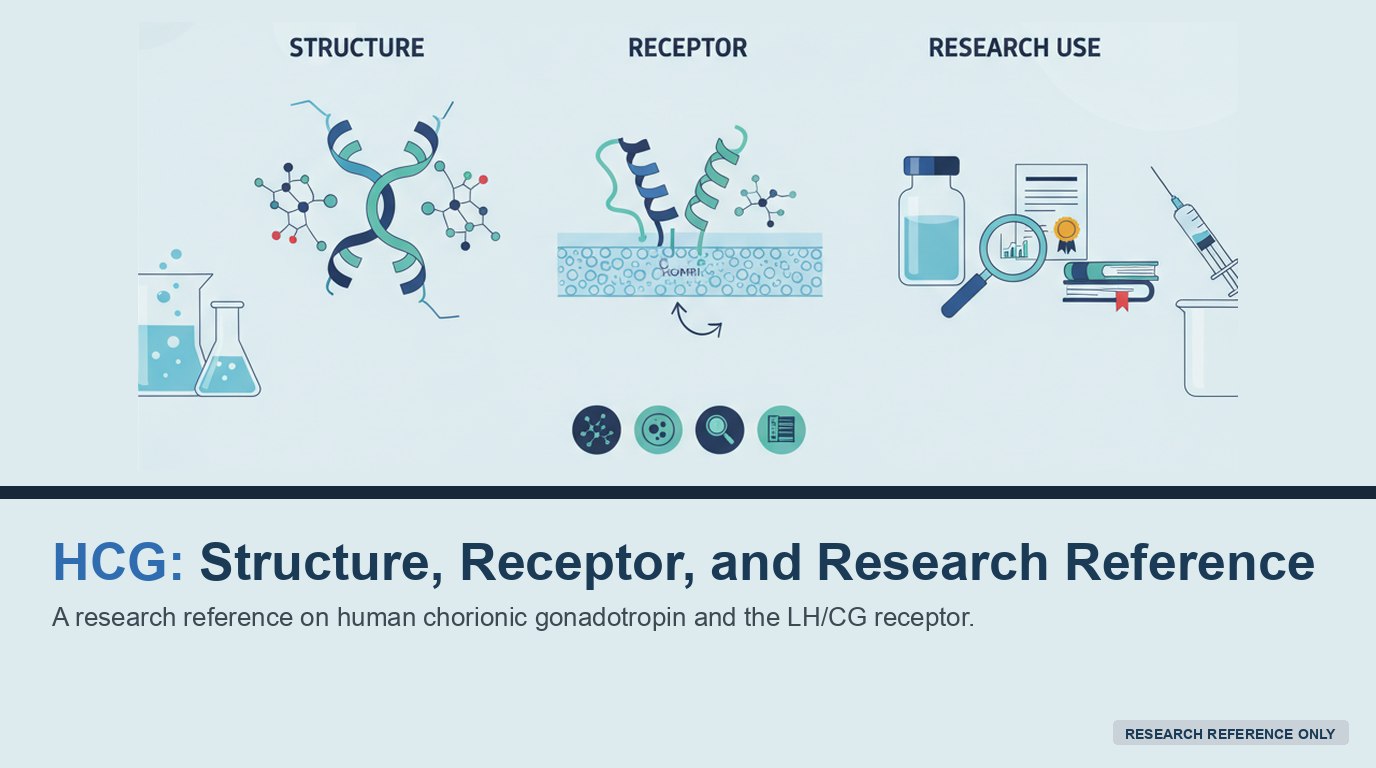
Quick answer: Human chorionic gonadotropin (hCG) is a glycoprotein hormone built from two different subunits, and it acts on the same receptor as luteinizing hormone, the LH/CG receptor (LHCGR). It is a large molecule, roughly 36.7 kDa, and it usually is quantified in International Units (IU) of biological activity rather than in milligrams. Prescription hCG drugs exist under brand names for specific medical indications; Velora’s research-grade hCG is not those products and is supplied for in vitro, ex vivo, and in silico research only.
Research use only: what this article is, and what it isn’t
This is a compound-education reference on human chorionic gonadotropin for researchers. It explains the hormone’s structure, its receptor, and the laboratory handling context for the research-grade material. It is not medical advice, not a fertility or hormone-therapy guide, and not a document about any human or veterinary use.
hCG is approved by the U.S. Food and Drug Administration as a prescription drug under brand names such as Pregnyl and Novarel for specific medical indications. Velora’s research-grade hCG is not those approved products, is not manufactured or quality-controlled as a drug, and is supplied strictly for in vitro, ex vivo, and in silico laboratory research, not for human consumption, veterinary use, in vivo use in any species, or any personal, fertility, or therapeutic application. Everything below describes the hormone’s biochemistry as established in the peer-reviewed literature. Researchers are responsible for compliance with applicable law, including the Federal Food, Drug, and Cosmetic Act (21 U.S.C. § 331, § 355, § 360bbb-3), and institutional review requirements.
What hCG is: a two-subunit glycoprotein
hCG is not a small peptide like most of the compounds a peptide lab handles; it is a glycoprotein hormone, and its architecture matters. It consists of two different protein subunits, an alpha subunit and a beta subunit, held together non-covalently. The alpha subunit is shared with several other pituitary hormones, while the beta subunit is what gives hCG its specific identity. Both subunits carry attached sugar chains, which is what makes it a glycoprotein, and that glycosylation is not decorative: it influences how the intact hormone folds, how stable it is, and how long it persists. The biology of hCG and its related molecular forms is reviewed in detail by Cole (Cole, *Reproductive Biology and Endocrinology*, 2010).
IU, milligrams, and molecular weight: three different numbers
One point causes more confusion around hCG than any other, so it is worth separating three quantities that are easy to conflate.
- Molecular weight (~36.7 kDa) describes the mass of one intact hCG molecule. It is a structural fact about the glycoprotein and, because glycosylation varies, an approximate one.
- Milligrams describe the gravimetric weight of material in a vial, including protein, sugar, salts, and residual moisture.
- International Units (IU) describe biological activity, calibrated against an international reference standard, not mass.
hCG is defined and supplied in IU rather than milligrams precisely because it is a glycoprotein whose activity per unit weight is not fixed: two preparations of identical mass can differ in activity if their glycoform profiles differ. The difference between hCG and luteinizing hormone, and the role glycosylation plays in it, is examined by Choi and Smitz (Choi & Smitz, *Molecular and Cellular Endocrinology*, 2014). For a researcher, the practical rule is simple: reason in IU for activity, note the approximate molecular weight for structural context, and do not try to convert cleanly between IU and milligrams, because no fixed conversion exists.
How it works: the LH/CG receptor
The reason hCG and luteinizing hormone (LH) get discussed together is that they act on the same receptor. That receptor is the lutropin/choriogonadotropin receptor, LHCGR, a G-protein-coupled receptor whose pharmacology was laid out comprehensively by Ascoli and colleagues (Ascoli et al., *Endocrine Reviews*, 2002). When hCG binds LHCGR, it activates the receptor and the downstream signaling cascade that LH would normally drive.
In the laboratory, that shared-receptor behavior is exactly what makes hCG a useful research tool. Its longer persistence compared with LH, a consequence of its heavier glycosylation, means researchers studying LHCGR signaling in cell-based systems often reach for hCG as a stable, well-characterized agonist of the receptor. This is a description of receptor pharmacology in experimental systems, not a statement about any effect in a person.
Laboratory handling: reconstitution and concentration
The information in this section is general laboratory-handling context, not a use protocol. Follow your own institution’s validated standard operating procedures and the applicable product documentation for any specific handling step.
hCG is supplied as a lyophilized powder in a 5000 IU vial. Because it is quantified in activity units, working concentrations are expressed in IU per milliliter. The values below are worked from Velora’s stated 5000 IU vial content.
| Diluent volume added | Resulting concentration (IU/mL) | Per 100 µL |
| 1.0 mL | 5000 | 500 IU |
| 2.0 mL | 2500 | 250 IU |
| 5.0 mL | 1000 | 100 IU |
As a general glycoprotein-handling practice, reconstitution is done by adding the diluent slowly down the inner glass wall and mixing by gentle swirling rather than shaking, because mechanical stress can denature a glycoprotein. Confirm activity and identity against the batch documentation before finalizing any dilution, and follow your validated procedures for the diluent, aliquoting, and labeling your protocol specifies.
What HPLC and mass spectrometry establish, and what they don’t
Velora states that each batch is independently verified by HPLC and mass spectrometry. It helps to be precise about what those methods do and do not confirm.
- They establish identity and purity. Mass spectrometry can confirm the expected subunits and characterize glycoform heterogeneity, and HPLC can quantify purity against related impurities. Intact-level mass analysis of hCG by these techniques is an active analytical field (Camperi et al., *Analytical and Bioanalytical Chemistry*, 2020).
- They do not, on their own, establish biological activity. A preparation can carry the right mass and purity and still have lost activity if the heterodimer has dissociated or denatured. Stated activity in IU comes from a calibrated bioassay, not from mass or purity data. So identity, purity, and activity are three separate confirmations, and a complete analytical picture reports all three.
“hCG is a glycoprotein, and that changes how I read a Certificate of Analysis compared with a synthetic peptide. Glycosylation is heterogeneous by nature, so I am not expecting a single razor-sharp mass the way I would for a 700-dalton pentapeptide. What I want is confirmed identity of both subunits, a stated activity in IU from a calibrated assay, and evidence the preparation was handled correctly so that the intact heterodimer is still assembled. A denatured glycoprotein can weigh the right amount and read pure and still do nothing at the receptor.”
Clark Jones, PhD, Velora Research
Storage
Keep the lyophilized vial sealed at -20°C, protected from light and moisture, and let it equilibrate to room temperature before opening. Glycoproteins are more sensitive to handling than small peptides, so as a general practice refrigerate reconstituted stock at 2 to 8°C, protect it from light, avoid freeze-thaw cycles by aliquoting into single-use portions, and never shake it. The broader logic of dry-versus-reconstituted storage is covered in the peptide storage guide. Velora has not published a reconstituted stability window for hCG, so establish the usable timeframe from your protocol and the batch documentation.
Working with verified material
Velora Research supplies HCG as a 5000 IU lyophilized vial, and Velora states each batch is independently HPLC- and mass-spec-verified with a Certificate of Analysis tied to the lot number, published through its Certificates of Analysis hub and linked from the product page. Those testing claims are Velora’s product-specific representations; verify the specifics for your lot on its COA. The same release protocol applies across the research peptide catalog, and the quality and testing process is documented end to end. For receptor-signaling research, starting from verified, intact material is what keeps an LHCGR result interpretable.
Frequently asked questions
What is hCG?
hCG (human chorionic gonadotropin) is a two-subunit glycoprotein hormone that activates the LH/CG receptor (LHCGR). Velora supplies it as research-grade material for in vitro, ex vivo, and in silico research use only, not as the approved prescription drug.
Why is hCG measured in IU instead of milligrams?
Because it is defined by biological activity rather than mass. As a glycoprotein with variable sugar content, its activity per unit weight is not fixed, so International Units (IU), calibrated against a reference standard, describe it more meaningfully than milligrams. No fixed IU-to-milligram conversion exists.
What receptor does hCG act on?
The lutropin/choriogonadotropin receptor (LHCGR), the same G-protein-coupled receptor that luteinizing hormone activates. hCG persists longer than LH, which is why it is a useful stable agonist in receptor research.
Does HPLC and mass-spec testing prove HCG is active?
No. Those methods confirm identity and purity, including glycoform characterization, but activity in IU comes from a separate calibrated bioassay. Identity, purity, and activity are three distinct confirmations.
Is Velora’s hCG the same as prescription hCG?
No. Prescription hCG products (such as Pregnyl and Novarel) are FDA-approved drugs for specific indications. Velora’s research-grade hCG is not those products and is supplied for laboratory research only, not for human or veterinary use.
Sources and further reading
- Cole LA. Biological functions of hCG and hCG-related molecules. Reproductive Biology and Endocrinology. 2010;8:102. PubMed
- Choi J, Smitz J. Luteinizing hormone and human chorionic gonadotropin: origins of difference. Molecular and Cellular Endocrinology. 2014;383(1-2):203-213. PubMed
- Ascoli M, Fanelli F, Segaloff DL. The lutropin/choriogonadotropin receptor, a 2002 perspective. Endocrine Reviews. 2002;23(2):141-174. PubMed
- Camperi J, Combès A, Fournier T, Pichon V, Delaunay N. Analysis of the human chorionic gonadotropin protein at the intact level by HILIC-MS and comparison with RPLC-MS. Analytical and Bioanalytical Chemistry. 2020;412(19):4423-4432. PubMed

About the author
Velorar Admin
For laboratory and research use only. This content is educational and does not constitute medical advice, nor does it describe use in humans.