Bacteriostatic Water for Peptides: What It Is and Why Researchers Use It
· 8 min read ·
Written by Clark Jones
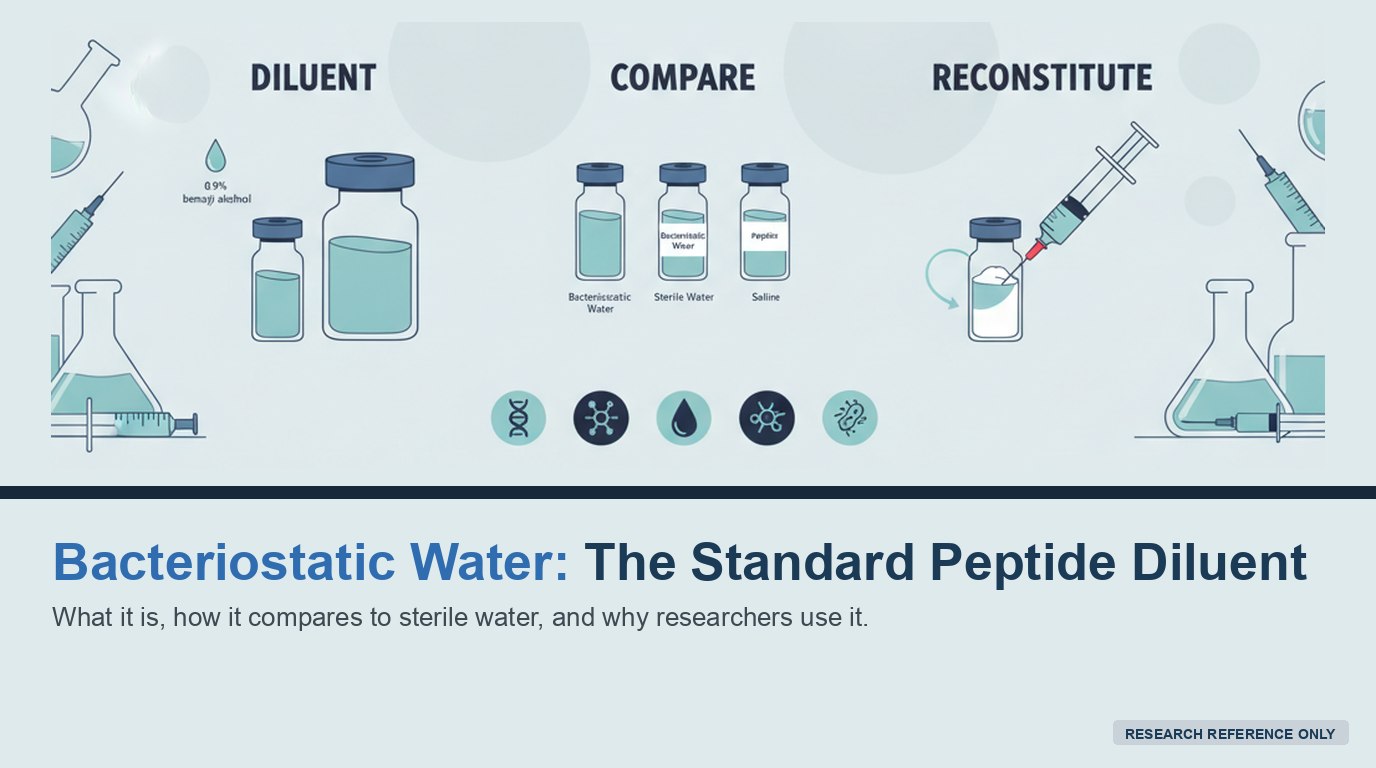
Quick answer: Bacteriostatic water is sterile water with 0.9% benzyl alcohol added as a preservative. That preservative inhibits microbial growth in the vial after each needle puncture, which is what lets a researcher draw from the same vial repeatedly rather than discarding it after one use. It is a common diluent for reconstituting lyophilized research peptides, but it is not automatically the right diluent for every peptide or every assay. Velora supplies it for laboratory research-peptide reconstitution only, not for any human or veterinary use.
Research use only, and one caveat up front
This is a laboratory-methods reference on the diluent used to reconstitute research peptides. It is not medical advice and not a guide to any human or veterinary injection. Velora Research supplies bacteriostatic water strictly for reconstituting research peptides in laboratory settings, not for human consumption, veterinary use, in vivo use in any species, or any personal or therapeutic application. Researchers are responsible for compliance with applicable law, including the Federal Food, Drug, and Cosmetic Act (21 U.S.C. § 331, § 355, § 360bbb-3), and institutional review requirements.
The caveat worth stating before anything else: bacteriostatic water is a common diluent for most peptides, but “most” is not “all.” Some peptides and some assays call for a different diluent, and the benzyl alcohol that makes bacteriostatic water convenient is exactly what makes it wrong for certain work. Keep that boundary in mind through everything below, because the rest of this article separates what bacteriostatic water is in general from what is appropriate for a specific peptide.
What bacteriostatic water is
Bacteriostatic water can be the same USP-grade sterile water used in pharmaceutical reconstitution, with one addition: benzyl alcohol, at a concentration of 0.9%, which works out to 9 mg per milliliter. That benzyl alcohol is a bacteriostatic agent, meaning it inhibits bacterial growth without fully sterilizing the solution. The distinction sounds subtle, but it is the entire point. Benzyl alcohol is one of the long-established antimicrobial preservatives used in multi-dose parenteral products precisely because it lets a sealed vial survive repeated needle entry without becoming a culture medium (Meyer et al., *Journal of Pharmaceutical Sciences*, 2007).
Its other relevant property is pH. Bacteriostatic water sits at a mildly acidic to neutral pH, which lands inside the range where many synthetic research peptides are stable in solution. That compatibility, plus the multi-dose convenience, is why it is a common choice for peptide reconstitution.
What bacteriostatic water does not mean
The word “bacteriostatic” carries more assumptions than it should. Being explicit about what it does not mean prevents the most common handling mistakes.
- It does not mean sterile after repeated use. The preservative inhibits bacterial growth; it does not guarantee sterility flowing repeated access. Repeated punctures and poor technique can still contaminate a vial.
- It does not mean universally compatible. Benzyl alcohol is not inert to every peptide, and some assays are sensitive to it. Bacteriostatic water is not automatically correct for all peptides.
- It does not preserve the peptide. The preservative protects the water against microbial growth. It is not intended to preserve the chemical or structural integrity of the dissolved peptide.
- It does not replace aseptic technique. The preservative is a backstop, not a substitute for clean handling.
- It does not protect against every contaminant. Bacteriostatic action targets bacteria; it is not a guarantee against all microbial or particulate contamination.
- It does not prove potency or purity. The diluent says nothing about whether the peptide you dissolved is what its label claims. That comes from the peptide’s Certificate of Analysis.
Benzyl alcohol is not always inert to the peptide
This point deserves its own section because it is the one researchers most often overlook. Benzyl alcohol is a useful preservative, but it is a small organic molecule that can interact with proteins and peptides. In the protein-formulation literature, benzyl alcohol has been shown to promote aggregation of a therapeutic protein under certain conditions of pH and temperature (Thirumangalathu et al., *Journal of Pharmaceutical Sciences*, 2006). The general degradation routes for peptides in solution, hydrolysis, oxidation, and aggregation, are catalogued in the protein-stability literature (Manning et al., *Pharmaceutical Research*, 2010).
The practical takeaways are two. First, benzyl alcohol can, for some sensitive peptides, contribute to instability, so a peptide’s own stability data should guide the diluent choice. Second, benzyl alcohol may potentially interfere with certain analytical readouts, so when an assay may be sensitive to it, a preservative-free sterile aqueous diluent may be preferable. Bacteriostatic water being a common default does not make it a universal default.
Bacteriostatic water vs sterile water vs saline
Three diluents come up when reconstituting peptides, and they are not interchangeable. The differences are at the formulation level. The table below outlines the general guidelines for each.
| Attribute | Bacteriostatic water | Sterile water for injection | 0.9% sodium chloride (saline) |
| Preservative | 0.9% benzyl alcohol | None | None |
| Sodium content | None | None | Yes (0.9%) |
| Reuse | Multi-dose (preservative inhibits growth) | Single use only | Single use only |
| Best research fit* | Standard peptide reconstitution | Single-use, or when benzyl alcohol could interfere | Only when an isotonic saline vehicle is specified |
*The appropriate diluent ultimately depends on the peptide’s formulation requirements, stability data, and assay.
For many lyophilized research peptides, bacteriostatic water is the diluent of choice. Sterile water for injection mat be preferred when a single-use reconstitution is required, or when the benzyl alcohol preservative could interfere with a sensitive assay or a benzyl-alcohol-sensitive peptide. Normal saline may be used when a research protocol specifically calls for an isotonic vehicle.
How reconstitution works
The information here is general laboratory-handling context, not a use protocol. Follow your institution’s validated procedures and the product documentation for any specific step. The standard bench workflow is straightforward, and the technique matters as much as the volume.
- Decide the target stock concentration your protocol needs, then divide the peptide vial amount by that concentration to get the volume of diluent to add.
- Wipe both vial stoppers with an alcohol pad.
- Draw the calculated volume into a sterile syringe.
- Insert the needle at roughly a 45-degree angle and release the water slowly down the inner glass wall, not directly onto the lyophilized powder.
- Let the peptide dissolve on its own, swirling gently. Do not shake: shaking foams the solution and can degrade peptide integrity.
- Once the solution is fully clear, label the vial with the date, concentration, and peptide identity, then refrigerate.
For worked concentration examples across common vial sizes, see our guide to reconstituting peptides.
Storage and stability
The storage and in-use figures below are Velora’s product specifications for its bacteriostatic water, drawn from the product documentation rather than from general scientific principle; treat them as product-specific and verify against the label and the batch documentation for your vial.
- Unopened: Velora specifies storage of sealed vials at 15 to 25°C, protected from direct light, with an unopened shelf life of up to 24 months. Do not freeze.
- After first puncture: Velora states the 0.9% benzyl alcohol preservative supports up to 28 days of multi-dose use when the vial is stored properly between withdrawals.
- The reconstituted peptide is a separate clock. How long a reconstituted peptide lasts depends on the peptide, not on the diluent. Velora’s general guidance is to refrigerate reconstituted vials at 2 to 8°C, but the usable window comes from peptide-specific stability data and the batch COA, not from the bacteriostatic water. Discard any vial that turns cloudy, discolored, or shows visible particulate.
“The mistake I see most often is treating the diluent and the peptide as one stability question. They are two, and conflating them is how good material quietly goes bad. Bacteriostatic water has a preservative window because of the benzyl alcohol, but that number says nothing about how long the peptide you dissolved in it stays intact, and in some cases the benzyl alcohol is itself a stressor. Match the diluent to the peptide and to the assay. The diluent is a variable in the experiment, not just a solvent.”
Clark Jones, PhD, Velora Research
Working with verified material
Velora Research supplies bacteriostatic water as USP-grade sterile water with 0.9% benzyl alcohol, in sealed 3 mL and 10 mL vials with multi-dose stoppers. It is the companion diluent for the research peptide catalog, each product of which ships with a batch-specific Certificate of Analysis published through the Certificates of Analysis hub. Good reconstitution accounts for both sides of the vial: a known diluent and a verified peptide.
Frequently asked questions
Does bacteriostatic mean sterile?
No. Bacteriostatic means the benzyl alcohol inhibits bacterial growth; it does not sterilize the solution or guarantee protection against every contaminant. Aseptic technique is still required.
Does benzyl alcohol affect peptide stability?
It can. Benzyl alcohol is a useful preservative, but it is not inert to every peptide, and it has been shown to promote protein aggregation under some conditions. For benzyl-alcohol-sensitive peptides, use the peptide’s stability data to choose the diluent.
Can benzyl alcohol interfere with an assay?
Yes, for some analytical readouts. When an assay may be sensitive to benzyl alcohol, single-use sterile water may be the preferred diluent.
Is bacteriostatic water right for every peptide?
No. It is a common diluent for most lyophilized research peptides, but some peptides and assays call for sterile water or an isotonic saline vehicle instead. Confirm compatibility for your specific peptide and assay.
What determines how long a reconstituted peptide lasts?
The peptide, not the bacteriostatic water. The diluent has its own multi-dose window; the reconstituted peptide’s usable window comes from peptide-specific stability data and the batch COA.
What should I check on the peptide’s COA before reconstituting?
Identity by mass spectrometry, purity by HPLC, and any storage or stability guidance for that specific compound. The diluent choice follows from the peptide’s requirements.
Sources and further reading
- Meyer BK, Ni A, Hu B, Shi L. Antimicrobial preservative use in parenteral products: past and present. Journal of Pharmaceutical Sciences. 2007;96(12):3155-3167. PubMed
- Thirumangalathu R, Krishnan S, Brems DN, Randolph TW, Carpenter JF. Effects of pH, temperature, and sucrose on benzyl alcohol-induced aggregation of recombinant human granulocyte colony stimulating factor. Journal of Pharmaceutical Sciences. 2006;95(7):1480-1497. PubMed
- Manning MC, Chou DK, Murphy BM, Payne RW, Katayama DS. Stability of protein pharmaceuticals: an update. Pharmaceutical Research. 2010;27(4):544-575. PubMed

About the author
Clark Jones
Clark Jones, PhD is a pharmaceutical scientist and medical writer with expertise in molecular biology, oncology, and chemistry. He has worked in the fields of oncology research, regenerative medicine, and pharmaceutical quality control, and holds extensive experience with peptide formulations and development in research. In his work, he translates complex scientific literature into evidence-based content while maintaining regulatory and scientific integrity. Every article he writes for Velora Research is grounded in primary sources and framed for a research audience. Read full bio ›
For laboratory and research use only. This content is educational and does not constitute medical advice, nor does it describe use in humans.