GLOW vs Wolverine Blend: Composition and Research-Scope Comparison
· 7 min read ·
Written by Clark Jones
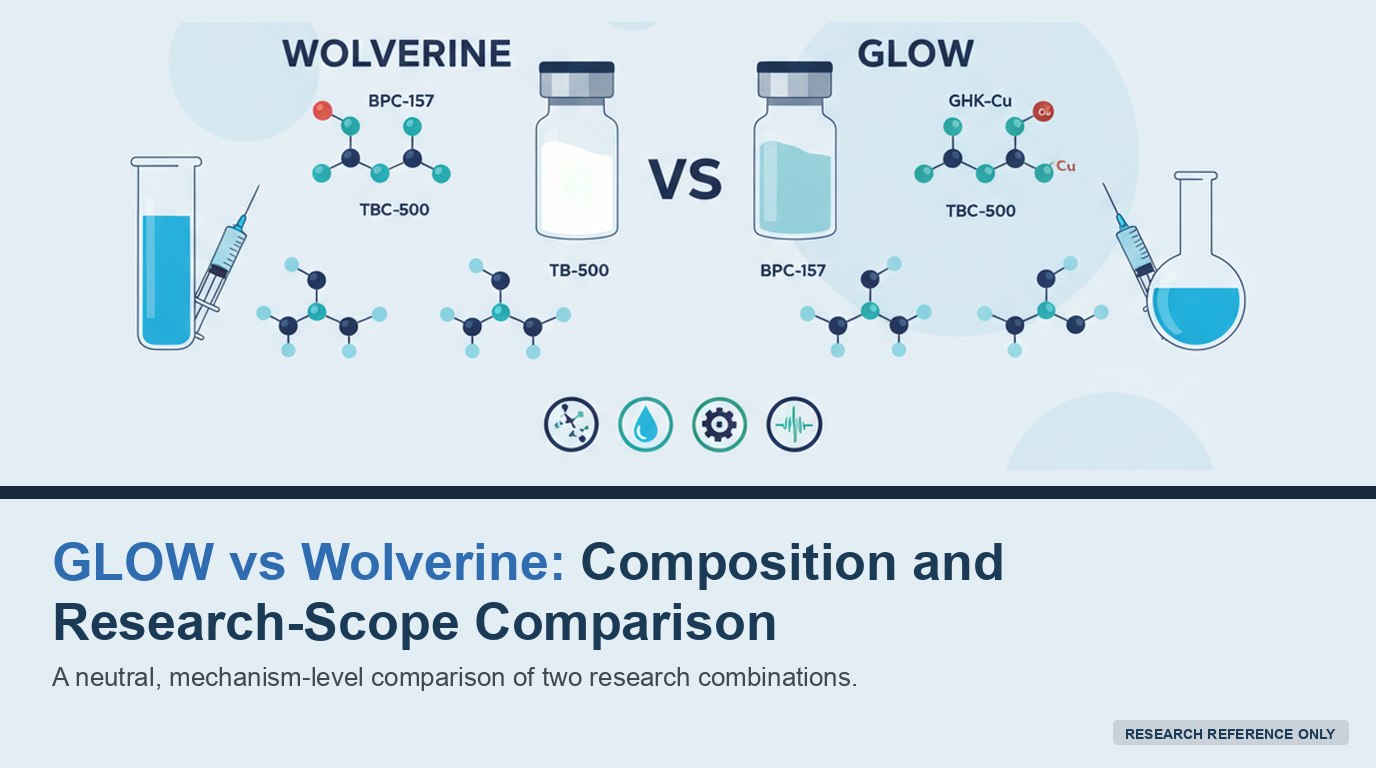
Quick answer: The Wolverine Blend and GLOW are two research combinations that share a core and then diverge. Both contain BPC-157 and TB-500. GLOW adds a third component, the copper tripeptide GHK-Cu, and contains a substantially larger total mass: 70 mg versus 10 mg in the Wolverine Blend, with each formulation maintaining its own fixed component ratio from Velora. So, the meaningful differences are composition, the research areas each component has been studied in, and the evidence available for each. Neither blend is FDA-approved, and Velora supplies both for in vitro, ex vivo, and in silico research only.
Research use only, and what this comparison is based on
This is a composition-level comparison of two research blends, written to help a researcher choose between them for a study design. It is not medical advice, not a treatment or self-administration guide, and not a document about any human, veterinary, or cosmetic use. None of the components in either blend is approved by the U.S. Food and Drug Administration in these formulations. Velora Research supplies both blends as research-grade material for in vitro, ex vivo, and in silico laboratory research only, not for human consumption, veterinary use, in vivo use in any species, or any personal or cosmetic application. This comparison describes how the two blends differ in composition and research scope; it does not rank one as better or claim any outcome for either. Researchers are responsible for compliance with applicable law, including the Federal Food, Drug, and Cosmetic Act (21 U.S.C. § 331, § 355, § 360bbb-3), and institutional review requirements.
What the published evidence does, and does not, tell us
Read this section before the comparison, because it frames everything that follows. The peer-reviewed research cited in this article is research on the individual components. It is not research on either assembled blend.
| Question | What the cited evidence represents |
| BPC-157 has published preclinical research | Yes |
| Thymosin beta-4 has published research | Yes (see the TB-500 caveat below) |
| GHK-Cu has published research | Yes |
| The three components have been studied individually | Yes |
| The exact GLOW formulation has published evidence | Not established by the cited sources |
| The exact Wolverine Blend formulation has published evidence | Not established by the cited sources |
| Combining the components produces an additive or synergistic effect | Not established by the cited sources |
The component sections below describe what each molecule has been studied for. They are not evidence for what either blend does as an assembled product.
Where they overlap: BPC-157 and TB-500
Both blends are built on the same two-peptide core. BPC-157 is a synthetic 15-amino-acid peptide examined in preclinical growth-factor, nitric-oxide, and angiogenesis models (Sikiric et al., *Current Pharmaceutical Design*, 2018). TB-500 is a synthetic peptide derived from the actin-binding region of thymosin beta-4, which has been characterized in the literature as an actin-modulating peptide (Goldstein et al., *Expert Opinion on Biological Therapy*, 2012). This pairing is Velora’s Wolverine Blend.
A note on TB-500 and thymosin beta-4. The cited literature describes thymosin beta-4 as a research background. That is not the same as evidence characterizing a specific commercial TB-500 material. The evidence of peer-reviewed scientific studies on TB-500 remains very limited. Treat a thymosin beta-4 paper as context for the molecular family, not as a performance claim for the TB-500 in any particular product.
Where they diverge: the copper tripeptide
The distinguishing component is GHK-Cu, the copper-bound form of the tripeptide glycyl-L-histidyl-L-lysine, which GLOW contains and the Wolverine Blend does not. GHK-Cu has been studied across copper-transport chemistry, reactive-oxygen-species pathways, gene-expression, and extracellular matrix research (Pickart & Margolina, *International Journal of Molecular Sciences*, 2018). Adding it introduces an additional research domain to the blend, involving copper-associated biology and extracellular-matrix research. To be careful about the language: GHK-Cu has been studied in those areas; that is not a statement that GLOW operates through those pathways as an assembled product. For a fuller treatment of the copper peptide, see the GLOW blend reference.
The two blends side by side
| Attribute | Wolverine Blend | GLOW |
| Components | BPC-157 + TB-500 | GHK-Cu + BPC-157 + TB-500 |
| Total mass | 10 mg | 70 mg |
| Fixed component ratio | 5 mg : 5 mg | 50 mg : 10 mg : 10 mg |
| Distinguishing component | None (the two-peptide core) | Adds GHK-Cu, the copper tripeptide |
| Research areas of components | BPC-157 and the TB-500/thymosin beta-4 related research | Adds GHK-Cu copper-associated and matrix research |
| Evidence basis | Literature on individual components; formulation-specific evidence must be evaluated separately | Literature on individual components; formulation-specific evidence must be evaluated separately |
| Appearance | White to off-white powder | Blue-tinted powder (copper coordination) |
| Handling note | Standard peptide handling | Velora documents the GHK-Cu component as light-sensitive and ships GLOW light-protected |
A note on the fixed ratios
Each blend holds its components at a fixed ratio, and that is worth reading correctly. A fixed ratio is a formulation and research-design characteristic: it means every aliquot from the vial carries the same proportions, which helps reproducibility. It is not evidence that the specific 5:5 or 50:10:10 ratio is biologically optimal. No cited source establishes an optimal ratio for either blend. So, use the fixed ratio as a reason to match a blend to a protocol that calls for those proportions, not as a claim that the proportions themselves have been validated.
Choosing between them for a study
The decision is not about which blend is stronger, a framing that does not apply to research materials. Prioritize these considerations, roughly in this order:
- Composition. Does your design call for the two-peptide core alone, or for the copper peptide as well? That single question separates the two blends.
- Fixed ratio. Does your protocol need the 5:5 proportion or the 50:10:10 proportion? Match the blend whose fixed ratio fits, since neither can be adjusted after the fact.
- Experimental variables. Adding GHK-Cu adds a variable. If a study is trying to isolate BPC-157 and TB-500, the Wolverine Blend keeps the copper peptide out of the design.
- Evidence base. For either blend, the available evidence is component-level, and formulation-level questions have to be evaluated separately. That is true of both, so it does not favor one over the other.
- Total amount. GLOW supplies more material (70 mg vs 10 mg), which suits larger preparations. A larger vial is only an advantage when the protocol actually requires those quantities; it is not itself a scientific reason to choose one blend. Keep in mind the total amount of each component within the blends as well.
“When two blends share components, the comparison lives in the Certificate of Analysis and the composition, not in the marketing. For either of these, I want identity by mass spectrometry and purity by HPLC on each peptide independently. And I would be careful to remember that everything I can cite is about the individual molecules. Pick the blend whose fixed ratio and components match your protocol, then let the COA confirm you actually have that composition. The literature sets the background; the COA describes your vial.”
Clark Jones, PhD, Velora Research
Working with verified material
Velora Research supplies both the Wolverine Blend and the GLOW blend, and Velora states each ships with a batch-specific Certificate of Analysis reporting identity by mass spectrometry and purity by HPLC for every component independently, published through the Certificates of Analysis hub. Those are Velora’s product-specific representations; confirm the specifics for your lot on its COA. The same release protocol applies across the research peptide catalog, and the quality and testing process is documented end to end. For a comparison between two overlapping blends, per-component verification is what makes the difference between them a real, reproducible variable.
Frequently asked questions
What is the difference between GLOW and the Wolverine Blend?
Both contain BPC-157 and TB-500. GLOW adds the copper tripeptide GHK-Cu and has a larger total mass (70 mg versus 10 mg), each blend holding its own fixed ratio. The differences are composition, component research areas, and total amount.
Which one should I use in research?
Choose based on composition and fixed ratio: the Wolverine Blend when a study centers on BPC-157 and TB-500 alone, and GLOW when the design includes the copper peptide. Neither is “stronger,” and formulation-level evidence for either must be evaluated separately.
Does the fixed ratio mean it is the optimal ratio?
No. A fixed ratio is a formulation and research-design characteristic that aids reproducibility. It is not evidence that the ratio is biologically optimal; no cited source establishes an optimal ratio for either blend.
Why is GLOW blue and light-sensitive?
The blue tint comes from the copper in GHK-Cu, which GLOW contains and the Wolverine Blend does not. Velora documents that copper component as light-sensitive and ships GLOW light-protected, so it should be kept dark.
Are these blends FDA-approved?
No. None of the components is FDA-approved in these formulations. Both are research-grade materials for in vitro, ex vivo, and in silico laboratory use only, not for human or veterinary use.
Sources and further reading
- Sikiric P, Rucman R, Turkovic B, et al. Novel cytoprotective mediator, stable gastric pentadecapeptide BPC 157. Current Pharmaceutical Design. 2018;24(18):1990-2001. PubMed
- Goldstein AL, Hannappel E, Sosne G, Kleinman HK. Thymosin β4: a multi-functional regenerative peptide. Expert Opinion on Biological Therapy. 2012;12(1):37-51. PubMed
- Pickart L, Margolina A. Regenerative and protective actions of the GHK-Cu peptide in the light of the new gene data. International Journal of Molecular Sciences. 2018;19(7):1987. PubMed

About the author
Clark Jones
Clark Jones, PhD is a pharmaceutical scientist and medical writer with expertise in molecular biology, oncology, and chemistry. He has worked in the fields of oncology research, regenerative medicine, and pharmaceutical quality control, and holds extensive experience with peptide formulations and development in research. In his work, he translates complex scientific literature into evidence-based content while maintaining regulatory and scientific integrity. Every article he writes for Velora Research is grounded in primary sources and framed for a research audience. Read full bio ›
For laboratory and research use only. This content is educational and does not constitute medical advice, nor does it describe use in humans.