How to Read a Peptide Certificate of Analysis: A Researcher’s Guide
· 6 min read ·
Written by Clark Jones
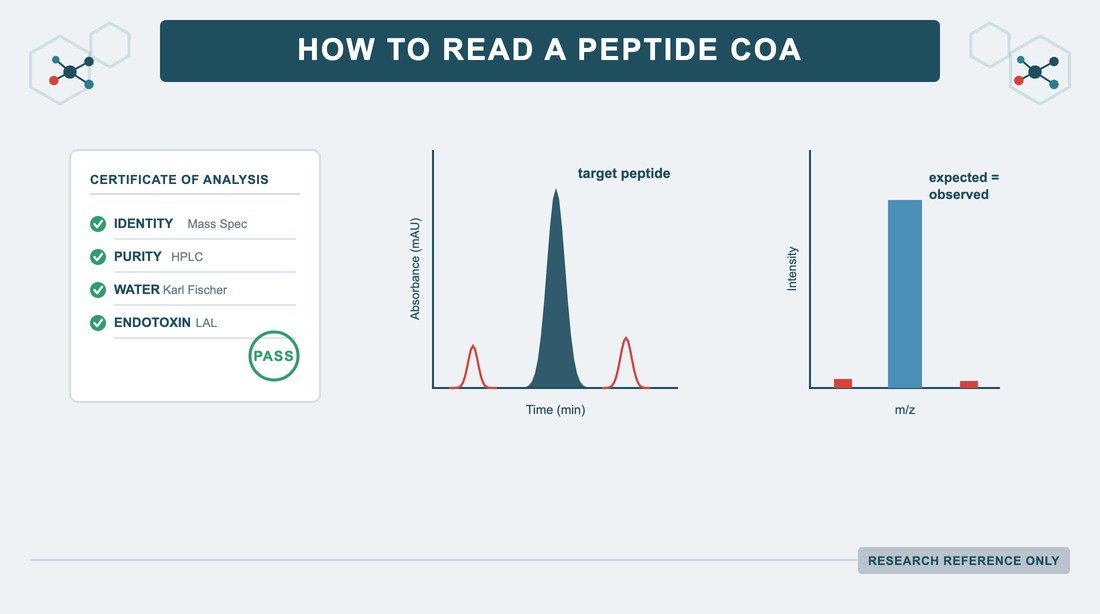
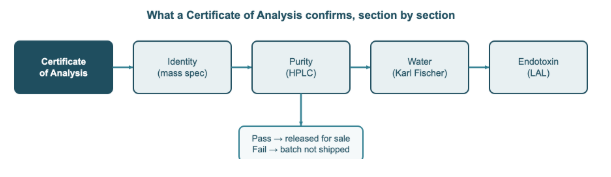
Quick answer: A Certificate of Analysis (COA) is the document that tells you what is actually in the vial. A high-quality research COA ideally confirms: identity by mass spectrometry, purity by HPLC, water content by Karl Fischer, and low bacterial endotoxin by LAL. It should be tied to a specific batch number and produced by a named third-party laboratory.
Research use only: what this article is, and what it isn’t
This is a methodology guide for researchers evaluating the analytical documentation that accompanies research-grade peptides. It is not medical advice and not a guide to any human use.
The compounds this article refers to are research peptides supplied for in vitro, ex vivo, and in silico laboratory research, not for human consumption, veterinary use, or in vivo use in any species. Reading a COA well is part of good research practice: it is how you confirm a compound’s identity and purity before you build a study around it. Researchers are responsible for compliance with applicable law, including the Federal Food, Drug, and Cosmetic Act (21 U.S.C. § 331, § 355, § 360bbb-3), and institutional review requirements.
Why the COA is the document that matters
Every research peptide protocol rests on a quiet assumption: that the vial contains the compound the label claims, at the purity the label claims. That assumption is only safe if someone checked, and the COA is the record of that check. A lyophilized white powder looks identical whether it is 99% pure target peptide or a mix of the target plus truncated sequences, oxidized variants, and residual synthesis reagents. The eye cannot tell them apart. The analytical instruments can, and the COA is where their answers get written down.
Here is how I read one, section by section.
Identity: mass spectrometry
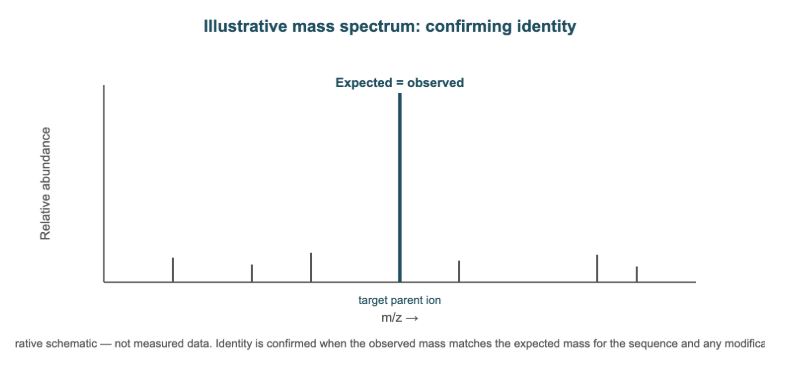
The first question is whether the vial contains the right molecule at all. Mass spectrometry answers it by measuring the molecular mass of the compound and comparing it to the expected value for the target peptide. On the COA, look for an observed mass that matches the theoretical mass for the sequence. For a modified peptide, this is where the modification has to show up: if you ordered a compound with an N-terminal acetyl group or a stabilizing tail, the mass should reflect that modification, not the bare sequence. A mass-spec result that confirms only a peptide of roughly the right length, without confirming the specific structure, is a weaker result than it looks.
Purity: HPLC
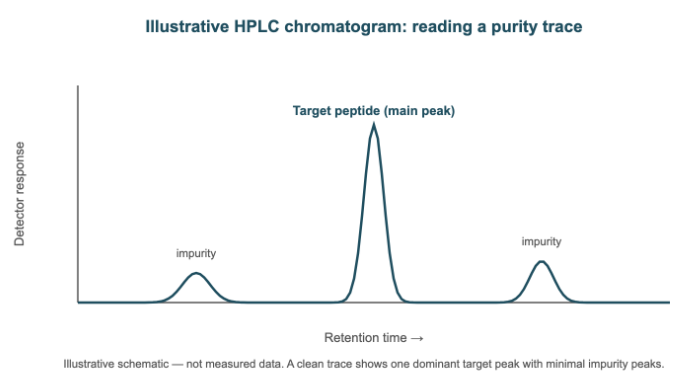
The second question is how much of what is in the vial is the target compound. High-performance liquid chromatography (HPLC) is widely used to assess peptide purity because it separates the sample into its individual components, resolving synthesis impurities and related sequences away from the target peptide so each can be quantified. Chromatographic separation of a target from its impurities is the reference approach for demonstrating specificity and purity in the international analytical-validation guideline (ICH Q2(R1), Validation of Analytical Procedures). On the COA you will see a purity percentage, and ideally a chromatogram, a trace showing one dominant peak for the target and small or absent peaks for impurities. High-quality research-grade peptides are commonly specified at ≥95% purity, with some suppliers releasing material at 99% or higher purity. The number matters, but so does the trace: a clean chromatogram with one sharp peak is more reassuring than a bare percentage with no picture, because the trace shows you whether the impurities are trace-level or a cluster of related sequences.
Water content: Karl Fischer
Lyophilized peptides hold residual water, and that water is part of the vial’s mass. Karl Fischer titration measures it. This matters more than researchers expect, because the gravimetric mass on the label includes water, salt, and counter-ions, not just peptide. If you are calculating a precise molar concentration, high water content means the actual peptide mass is lower than the label weight suggests because the gravimetric weight includes moistures rather than peptide. A COA that reports water content lets you account for it.
Endotoxin: LAL
Bacterial endotoxin is a contaminant that can confound cell-based and immunological assays even at low levels. The Limulus amebocyte lysate (LAL) assay measures it. For research peptides destined for cell culture and other endotoxin-sensitive biological assays, a low endotoxin result on the COA is what keeps an inflammatory or immune readout from being an artifact of contamination rather than a real effect of the compound.
The full analytical picture
| COA section | Method | What it confirms |
|---|---|---|
| Identity | Mass spectrometry | The compound is the target molecule, including any modification |
| Purity | HPLC | The proportion of the sample that is the target peptide (typically ≥99%) |
| Water content | Karl Fischer titration | Residual moisture, which affects the true peptide mass |
| Endotoxin | LAL assay | Low bacterial endotoxin, important for cell-based assays |
| Heavy metals / residual solvents | ICP-MS or equivalent | Low elemental contaminants |
| Residual Solvents | GC-MS or equivalent | Low synthesis solvent residues |
The red flags
A COA can be present and still be weak. These are the things I treat as warning signs:
- No batch number. A COA that is not tied to a specific lot cannot be matched to the vial in your hand. It could describe a different batch entirely.
- No named third-party laboratory. A self-reported purity number with no independent lab or validated internal quality control behind it is a claim, not a verification.
- A percentage with no chromatogram. The number without the trace hides whether the impurities are trace-level or a cluster of related sequences.
- Identity confirmed only by length. Mass spec that confirms a peptide of roughly the right size, without confirming the expected modified molecular mass is not full identity confirmation.
- No endotoxin or water-content data. For a compound going into cell-based work or precise molar calculations, those omissions matter.
“The COA is the single most important document in the whole transaction, and most people barely read it. I look at four things in order: does the mass spec confirm the exact structure, is the HPLC trace clean and not just a number, is the water content reported so my molar math is honest, and is the endotoxin low enough for cell work. If a batch fails any of those, it does not go into a study. There is no shortcut on this for material that is going to inform published data.”
Clark Jones, PhD, Velora Research
How Velora documents every batch
Velora Research publishes a batch-specific Certificate of Analysis for every product, accessible on the COAs page and linked from each product page by lot number. Each COA reports identity by mass spectrometry, purity by HPLC at ≥99%, and the supporting analytical package, produced by an independent third-party laboratory. The same release protocol applies across the research peptide catalog, and the full quality and testing process is documented end to end. If a batch does not pass, it does not ship.
Sources and further reading
- International Council for Harmonisation. ICH Q2(R1): Validation of Analytical Procedures: Text and Methodology. ICH guideline
Frequently asked questions
What should a peptide COA include?
A comprehensive research COA ideally includes: identity by mass spectrometry, purity by HPLC (with a chromatogram, not just a percentage), water content by Karl Fischer, and bacterial endotoxin by LAL, all tied to a specific batch number and produced by a named third-party laboratory or validated internal quality control.
What does “third-party tested” actually mean?
It means the analysis was performed by an independent laboratory, not self-reported by the seller. A named third-party lab or validated internal quality control check on the COA is what separates a verified result from an unverified claim.
Why does HPLC purity matter so much?
HPLC separates the target peptide from impurities such as truncated or modified sequences and measures the proportion that is the target. A 99% or higher result, backed by a clean chromatogram, is what tells you the vial is mostly the compound you intended to study.
Why is water content on the COA?
Because the label mass includes residual water, salt, and counter-ions, not just peptide. Karl Fischer water content lets you calculate a more accurate molar concentration from the gravimetric mass.
What is the biggest COA red flag?
No batch number or no named third-party laboratory. Either one means the document cannot be matched to the specific vial or independently trusted.

About the author
Clark Jones
Clark Jones, PhD is a pharmaceutical scientist and medical writer with expertise in molecular biology, oncology, and chemistry. He has worked in the fields of oncology research, regenerative medicine, and pharmaceutical quality control, and holds extensive experience with peptide formulations and development in research. In his work, he translates complex scientific literature into evidence-based content while maintaining regulatory and scientific integrity. Every article he writes for Velora Research is grounded in primary sources and framed for a research audience. Read full bio ›
For laboratory and research use only. This content is educational and does not constitute medical advice, nor does it describe use in humans.