CJC-1295 No DAC + Ipamorelin: Co-Administration Mechanism and Research Reference
· 7 min read ·
Written by Clark Jones
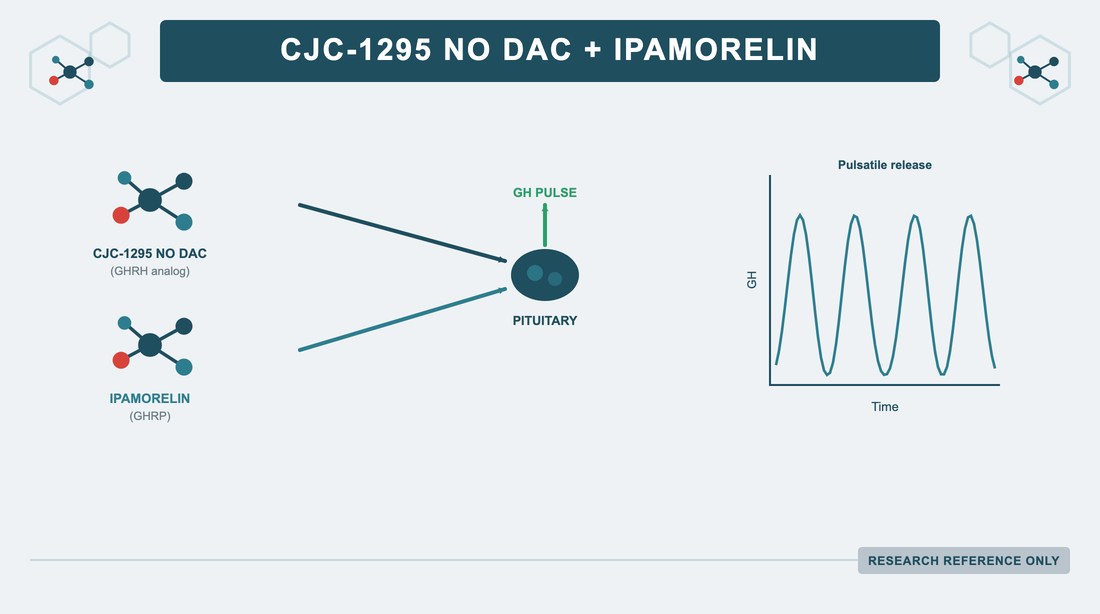
Quick answer: CJC-1295 No DAC and ipamorelin are two growth-hormone-axis research peptides that act on different receptors, which is why they are often studied together. CJC-1295 No DAC (also called Modified GRF 1-29) is a stabilized GHRH analog with a relatively short functional half-life of roughly 30 minutes. Ipamorelin is a selective ghrelin-receptor agonist. Neither is FDA-approved for any use, and Velora supplies the pair as a research compound for in vitro, ex vivo, and in silico work only.
Research use only: what this article is, and what it isn’t
This article explains the mechanism and reconstitution of a co-formulated CJC-1295 No DAC and ipamorelin research blend. It is not medical advice, not a prescribing or self-administration guide, and not a human dosing document.
Neither CJC-1295 No DAC nor ipamorelin is approved by the U.S. Food and Drug Administration, the European Medicines Agency, or any other regulator for any therapeutic indication. The blend Velora Research supplies is research-grade material sold strictly for in vitro, ex vivo, and in silico laboratory research, not for human consumption, veterinary use, or in vivo use in any species. The word “co-administration” throughout this article refers to a research-design choice in a controlled experiment, not to any human or veterinary use.
Mechanisms described below are drawn from published preclinical and clinical literature on each compound and are reported here for research orientation. Researchers are responsible for compliance with applicable law, including the Federal Food, Drug, and Cosmetic Act (21 U.S.C. § 331, § 355, § 360bbb-3), and institutional review requirements.
The two compounds act on two different receptors
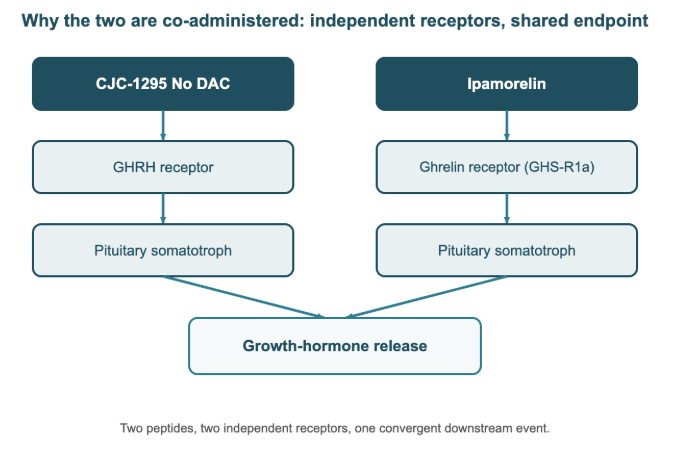
The single most useful thing to understand about this pair is that they engage independent receptor systems on the same pituitary cell population.
CJC-1295 No DAC is a synthetic analog of growth-hormone-releasing hormone (GHRH). It is a 30-amino-acid peptide derived from the first 29 residues of native GHRH, with four amino-acid substitutions that resist enzymatic degradation. It is also called Modified GRF 1-29. It binds the GHRH receptor. Its molecular weight is approximately 3,367.95 g/mol per Velora’s product specifications, with the formula C152H252N44O42 and CAS number 863288-34-0.
Ipamorelin is a synthetic pentapeptide (Aib-His-D-2-Nal-D-Phe-Lys-NH2) that binds a completely different receptor, the ghrelin receptor, also known as the growth-hormone secretagogue receptor 1a (GHS-R1a). Its molecular weight is approximately 711.86 g/mol, with the formula C38H49N9O5 and CAS number 170851-70-4. Ipamorelin was originally characterized by Raun and colleagues at Novo Nordisk in 1998, and its defining feature in the growth-hormone-releasing-peptide class is selectivity: it acts on the ghrelin receptor without the cortisol and prolactin elevations that older peptides in the class produced (Raun et al., European Journal of Endocrinology, 1998).
| Compound | Class | Receptor | Molecular weight | Functional half-life (research) |
|---|---|---|---|---|
| CJC-1295 No DAC | Stabilized GHRH analog | GHRH receptor | ~3,367.95 g/mol | ~30 minutes |
| Ipamorelin | Selective ghrelin-receptor agonist | GHS-R1a (ghrelin receptor) | ~711.86 g/mol | ~2 hours |
The “No DAC” part matters
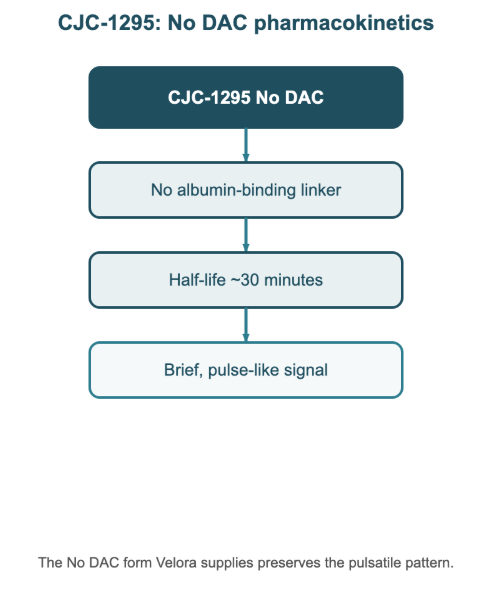
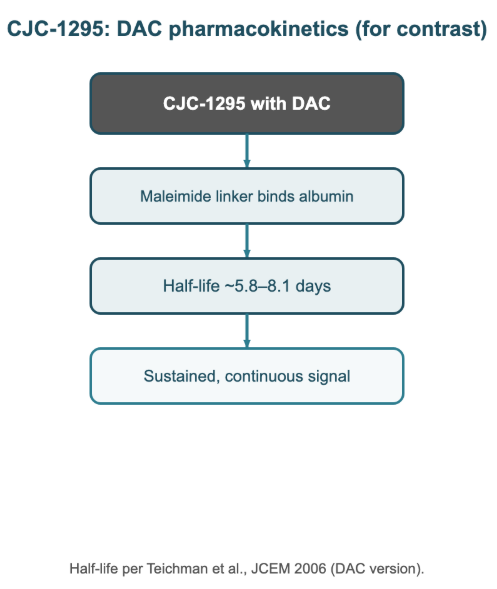
CJC-1295 exists in two research forms, and the difference is entirely about half-life. The DAC version carries a maleimide drug-affinity-complex linker that binds plasma albumin, which extends its functional half-life to several days. In the published human pharmacokinetic study of the DAC version, Teichman and colleagues reported an estimated half-life of 5.8 to 8.1 days, with elevated IGF-1 for up to 28 days after multiple doses (Teichman et al., Journal of Clinical Endocrinology and Metabolism, 2006).
The No DAC version omits that linker. Without it, the functional half-life drops to roughly 30 minutes. That short window is the reason researchers reach for the No DAC form in the first place: it produces a brief, pulse-like signal rather than the sustained, continuous receptor activation the DAC version drives. Research protocols that aim to model the natural pulsatile pattern of GHRH release use the short-acting form.
| Attribute | CJC-1295 No DAC | CJC-1295 with DAC |
|---|---|---|
| Albumin-binding linker | No | Yes (maleimide DAC) |
| Functional half-life | ~30 minutes | ~5.8 to 8.1 days (Teichman et al., 2006) |
| Signaling pattern | Brief, pulse-like | Sustained, continuous |
| Typical research pairing | Co-administered with a ghrelin-receptor agonist for pulse-pattern models | Studied alone for continuous-signal models |
Velora’s product is the No DAC version, which is why it is paired with ipamorelin: both compounds have relatively short functional half-lives, making the combination suitable for research protocols intended to study pulsatile GH-axis signaling.
Why the two are studied together
Because CJC-1295 No DAC binds the GHRH receptor and ipamorelin binds the ghrelin receptor, the two engage independent pathways that converge on the same downstream event, growth-hormone release from pituitary somatotrophs. In published preclinical literature, the combination of a GHRH analog with a growth-hormone-releasing peptide has been described as producing additive or synergistic effects on growth-hormone release magnitude in animal models, compared with either compound alone. That convergence on independent pathways is the mechanistic rationale for co-administration research, and it is why this fixed-ratio pairing shows up so often in the literature.
To be precise about the framing: this is a description of published animal-model research, not a claim about what the Velora product does. The pairing is a research-design configuration, and the additive-effect observations belong to the studies that reported them.
Reconstitution and concentration
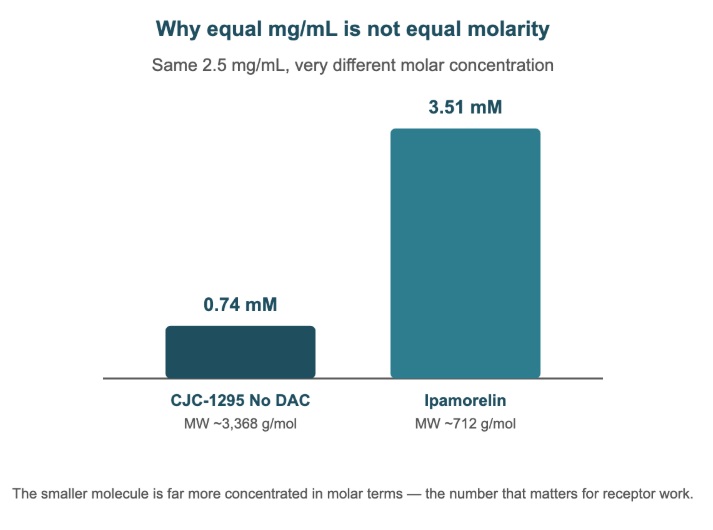
The blend ships as a single lyophilized vial containing 5 mg of CJC-1295 No DAC and 5 mg of ipamorelin, 10 mg of peptide total. A common laboratory reconstitution is 2 mL of bacteriostatic water, which yields a 5 mg/mL combined stock, or 2.5 mg/mL of each component.
| BAC water volume | Each component (mg/mL) | CJC-1295 No DAC (mM) | Ipamorelin (mM) |
|---|---|---|---|
| 1.0 mL | 5.0 each | ~1.48 | ~7.02 |
| 2.0 mL | 2.5 each | ~0.74 | ~3.51 |
| 4.0 mL | 1.25 each | ~0.37 | ~1.76 |
Molar values use Velora’s product-page molecular weights (3,367.95 g/mol for CJC-1295 No DAC, 711.86 g/mol for ipamorelin). Note how different the two molar concentrations are at the same gravimetric concentration: ipamorelin is roughly 4.7 times smaller, so a 2.5 mg/mL solution is far more concentrated in molar terms. For receptor-binding work, that difference is the one that matters.
Reconstitute with the standard slow-stream technique against the inner glass wall, swirl gently, and confirm both molecular weights against the batch Certificate of Analysis before finalizing dilutions.
For storage, keep the lyophilized vial sealed at -20°C, protected from light, and refrigerate reconstituted stock at 2 to 8°C. Avoid freeze-thaw cycles. Velora has not published a reconstituted stability window for this product, so establish the usable timeframe from your protocol and the batch COA.
“A co-formulated vial like this one is only as good as its per-component analysis. I want to see identity by mass spectrometry and purity by HPLC for both peptides independently, not a single combined number. The two molecules are wildly different sizes, and a clean COA proves you have both at the ratio the label claims. That is the whole basis for using a fixed-ratio blend in the first place.”
Clark Jones, PhD, Velora Research
Working with verified material
Velora Research supplies the CJC-1295 No DAC and ipamorelin blend with a batch-specific third-party Certificate of Analysis that reports identity by mass spectrometry and purity by HPLC at ≥99% per component. The same release protocol applies across the research peptide catalog, and the quality and testing process is documented end to end. For a fixed-ratio blend, per-component verification is what makes a co-administration result reproducible.
Frequently asked questions
What is CJC-1295 No DAC?
CJC-1295 No DAC is a synthetic 30-amino-acid GHRH analog, also called Modified GRF 1-29. It lacks the drug-affinity-complex linker of the DAC version, which gives it a short functional half-life of roughly 30 minutes and a pulse-like signaling pattern. Velora supplies it as a research compound for in vitro, ex vivo, and in silico work only.
What is the difference between CJC-1295 No DAC and CJC-1295 with DAC?
The DAC version has a maleimide linker that binds plasma albumin, extending its functional half-life to roughly 5.8 to 8.1 days for sustained continuous signaling. The No DAC version omits the linker, producing a much shorter half-life (about 30 minutes) and preserving a pulsatile pattern. Research protocols choose between them based on whether the study models continuous or pulsatile GHRH signaling.
Why is ipamorelin paired with CJC-1295 No DAC?
Both compounds have short functional half-lives, which preserves the pulsatile signaling pattern that published research most often models. The two act on independent receptors (GHRH receptor and ghrelin receptor), so co-administration lets researchers study convergent growth-hormone-axis signaling.
Is the CJC-1295 No DAC and ipamorelin blend FDA-approved?
No. Neither compound is approved by the FDA or any other regulator for any indication. The blend is research-grade material for in vitro, ex vivo, and in silico laboratory use only, not for human or veterinary use.
What are the molecular weights?
Approximately 3,367.95 g/mol for CJC-1295 No DAC and 711.86 g/mol for ipamorelin, per Velora’s product specifications. Confirm both on the batch COA before calculating molar concentrations.
Sources and further reading
- Teichman SL, Neale A, Lawrence B, Gagnon C, Castaigne JP, Frohman LA. Prolonged stimulation of growth hormone (GH) and insulin-like growth factor I secretion by CJC-1295, a long-acting analog of GH-releasing hormone, in healthy adults. Journal of Clinical Endocrinology and Metabolism. 2006;91(3):799-805. PubMed
- Raun K, Hansen BS, Johansen NL, et al. Ipamorelin, the first selective growth hormone secretagogue. European Journal of Endocrinology. 1998;139(5):552-561. PubMed

About the author
Clark Jones
Clark Jones, PhD is a pharmaceutical scientist and medical writer with expertise in molecular biology, oncology, and chemistry. He has worked in the fields of oncology research, regenerative medicine, and pharmaceutical quality control, and holds extensive experience with peptide formulations and development in research. In his work, he translates complex scientific literature into evidence-based content while maintaining regulatory and scientific integrity. Every article he writes for Velora Research is grounded in primary sources and framed for a research audience. Read full bio ›
For laboratory and research use only. This content is educational and does not constitute medical advice, nor does it describe use in humans.